
Labour Shortages Rarely Happen Overnight: When Should Recruitment Begin?
Key Takeaway
A labour shortage Malaysia employers find themselves managing is almost always something that built up slowly. The pressure did not appear on a Monday morning. It started months earlier, a workforce shortage building quietly while the operation kept running.
Manufacturing holds the largest share of job vacancies in Malaysia. As of Q4 2025, 115,800 of the country's 198,100 open positions were in manufacturing alone. That is over half of all unfilled roles nationally.
The lead time for a foreign worker to arrive and be work-ready in Malaysia runs to several months when Section 60K approval, quota application, Calling Visa, and FOMEMA screening are factored in.
Warning signals appear weeks or months before production is affected. Reading them early is the difference between a planned recruitment and a crisis hire.
Manpower planning that starts at the point of pressure is already late. The calculation should begin with the lead time and work backwards from the date the worker is needed on-site.
Introduction
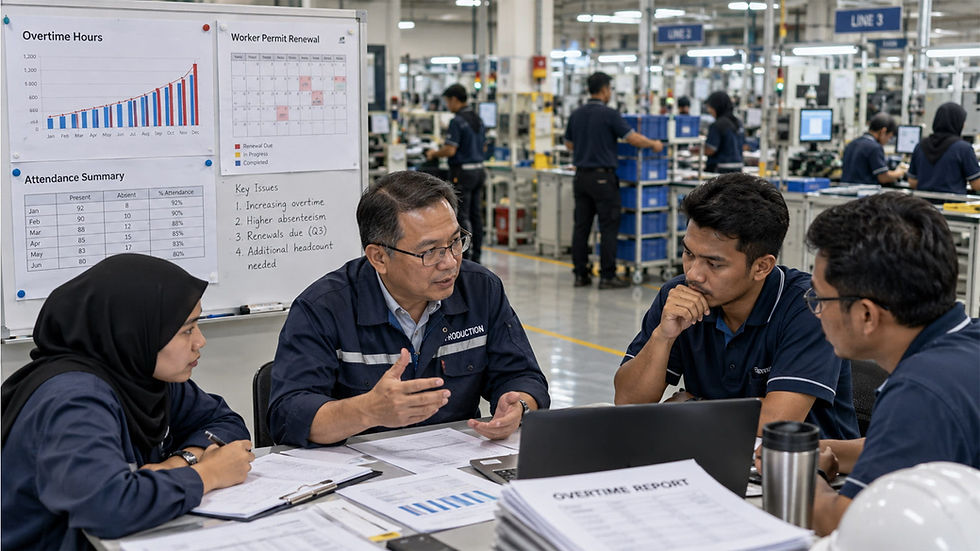
Most employers realise they have a staff shortage when the floor manager raises it in a production meeting. By that point, the problem has usually been visible for weeks: in the overtime numbers, in the attendance sheets, in the renewal calendar that nobody checked.
A labour shortage in Malaysia does not materialise overnight. The conditions that create it develop gradually. Permit renewals that cluster in the same quarter. A couple of long-tenured workers who left and were not replaced. An order book that grew faster than the headcount. None of these feel urgent on their own. Together, they set the stage for a shortage that looks sudden but was not.
The question is not what to do once a labour shortage in Malaysia has arrived, but when recruitment should have started and how to calculate that window before it closes.
Why Labour Shortages Build Up Before They Are Felt
Why Does a Vacant Role Take Months to Affect Output?
When a worker leaves, there is usually a grace period before the vacancy causes a measurable problem. Other workers absorb the load. Overtime fills the gap. Output dips slightly but not enough to trigger an alarm. This grace period masks the underlying shortage, sometimes for two or three months, and by the time the mask comes off, the recruitment clock has been ticking for a while already.
How Do Permit Expiry Clusters Create a Sudden Staff Shortage?
Foreign workers on VP(TE) permits often arrive in batches. Workers recruited together tend to have permits that expire in the same window. An employer who hired twenty workers in the same month in 2023 may find that permits cluster for renewal in the same quarter. If some of those workers are not renewed or choose not to return, the gap does not appear one by one. It appears as a block.
Checking the permit expiry calendar twelve months out, not three months out, gives employers time to plan rather than react.
What Happens When Order Books Grow Faster Than Headcount?
Production targets shift upward. A new contract comes in. The operations team adjusts the line capacity. But if the order book grows without a parallel headcount review, the workers needed to meet the new target get overlooked until the line is short-staffed.

What Does the Recruitment Lead Time Look Like in Malaysia?
If you do not know the real lead time, you cannot make a sensible call about when to start.
A foreign worker in Malaysia is not a hire that happens in a few weeks. From deciding to recruit to a worker being on-site and cleared, the lead time runs to several months.
Here is what builds up inside that window:
Section 60K Approval
Before any foreign worker can be recruited, the employer needs Section 60K approval from JTKSM. This requires advertising the role on MYFutureJobs first. The advertising period, submission, and JTKSM review all add time before the quota application can even begin.
Quota Application
Once Section 60K is in place, the eQuota application goes through FWCMS. Processing depends on sector, headcount, and whether the application is complete. Incomplete or misclassified applications stall and add weeks to the timeline.
Calling Visa and Source Country Process
After quota approval, the Calling Visa (eVDR) application is submitted. The worker then needs to obtain a Single Entry Visa at the Malaysian embassy in their home country. Source country sending authority approvals in Nepal, Bangladesh, and Indonesia add a further step that many employers underestimate.
FOMEMA Screening After Arrival
When the worker arrives, FOMEMA health screening must be completed before the VP(TE) and i-Kad are issued. Until that clearance comes through, the worker is not legally permitted to work.
Stack them in sequence, and the gap between "we need workers" and "the worker is cleared to start" adds up quickly.
What Are the Warning Signs of a Labour Shortage Before It Hits?
Every operation has measurable signals that a shortage is forming earlier than it feels.
What Does Rising Overtime Tell You About Workforce Shortage Risk?
A steady increase in overtime (particularly when output is not rising proportionally) suggests the existing headcount is absorbing work that should belong to additional positions. When overtime climbs without a matching rise in output, the buffer has shrunk.
Why Does Absenteeism Rise Before a Labour Shortage Becomes Obvious?
Workers covering for short headcount burn out and absenteeism climbs. Tracking the trend monthly, rather than reacting to individual incidents, surfaces this signal before it sharpens.
How Far Ahead Should You Check Permit Expiry Dates?
Pull the permit expiry dates for the entire foreign workforce. If a significant number expire within the same sixty-day window, that window is a risk point. Some of those workers will not renew. Starting the conversation at least six months before that window opens is what separates a planned response from a scramble.
What Do Vacancy Numbers Tell You That Overtime Figures Do Not?
If the number of unfilled positions as a percentage of total headcount starts climbing, that is a leading indicator. Malaysia's overall job vacancy rate sat at 2.1 per cent in Q1 2026. In manufacturing specifically, vacancies accounted for over half of all unfilled roles nationally. An individual employer running above industry vacancy norms is dealing with a more acute labour shortage in Malaysia than the headline numbers suggest.
When Should Recruitment Actually Begin?
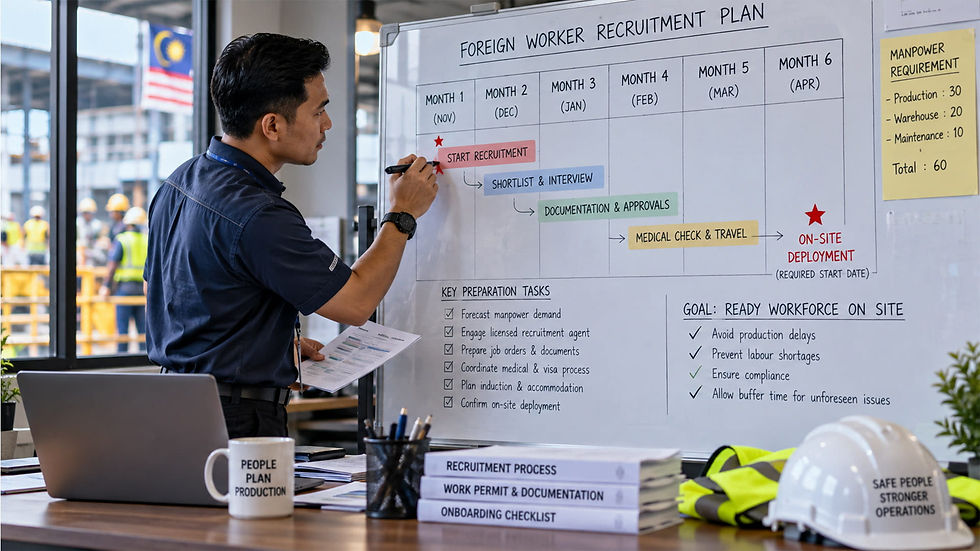
Solid manpower planning means working out when workers need to be on-site, subtracting the full recruitment lead time, and acting on that date rather than waiting for urgency to force the decision. That is when action to avoid a labour shortage Malaysia employers dread should already have begun.
If the worker needs to be productive on site by Month 6, recruitment preparation, including Section 60K advertising, should be underway by Month 1 or earlier.
This is the root of the staff shortage Malaysian businesses create for themselves most often. They plan backwards from urgency rather than forwards from lead time. The booking deadline for a production run is set. The contract is signed. Then someone asks about the workers.
Plantation and agriculture recruitment has seasonal dependency. Certain source countries have sending windows that do not flex regardless of how urgent the employer's need is. Construction projects with fixed start dates have zero tolerance for delayed headcount. Manufacturing operations with continuous shifts cannot absorb gaps the way a project-based team might.
Frequently Asked Questions
1. What is the typical lead time for a foreign worker to be on-site in Malaysia from the start of the recruitment process?
The full timeline runs through Section 60K approval, MYFutureJobs advertising, the eQuota application, and Calling Visa processing. Beyond that, the worker still needs source country preparation, a Single Entry Visa from the Malaysian embassy, travel, and FOMEMA clearance after arriving. Starting when you feel the pressure is almost always too late.
2. What internal signals tell an employer a labour shortage in Malaysia is forming before it becomes a crisis?
The clearest signals of a workforce shortage forming are rising overtime that does not track with output growth, increasing absenteeism, a permit expiry calendar with a concentration of dates in one window, and a vacancy-to-headcount ratio that is climbing. Any of these on their own deserves attention. Two or more at the same time is a signal to start recruiting now.
3. Why does recruitment need to start earlier in some sectors when a labour shortage is building?
Plantation and agriculture recruitment follows sending windows in certain source countries. Those windows do not flex based on employer urgency. Construction projects have fixed site-start dates and cannot accommodate delayed headcount. Manufacturing with continuous shift operations has very little tolerance for gaps. Each sector has its own minimum lead time, and planning needs to account for the tightest constraint, not the most optimistic one.
4. How can permit expiry dates signal a labour shortage before recruitment pressure is felt?
When foreign workers' VP(TE) permits expire in the same window, because they were recruited in the same batch, some will not return for another cycle. If those non-renewals are not anticipated and planned for in advance, the employer wakes up to a sudden headcount gap that was actually visible on the permit calendar twelve months earlier. Reviewing expiry dates a year out and flagging concentration points is the simplest way to prevent a staff shortage Malaysia employers were not expecting.
5. When a labour shortage is forming, does it matter whether the business uses a recruitment agency or hires directly?
It changes who does the work, not the order it happens in. With a licensed manpower supply agency, the agency takes on the paperwork and source-country coordination. Direct hirers handle each stage in-house, so the lead time risk sits with them. Either way, the stages still run one after another, so the timing principle is the same: start earlier than the urgency demands. A staff shortage in Malaysia that a business ends up managing often traces back to a hire that was planned too late.
A labour shortage in Malaysia is rarely a surprise in hindsight. The signals were there. The permit calendar had the dates. The overtime numbers were climbing. The order book had outgrown the headcount. What was missing was the decision to act while time was still on their side. The full recruitment lead time for a foreign worker in Malaysia runs to several months from the first step to cleared-for-work. That is the number every manpower planning conversation should start with. Get in touch with UMR's manpower supply service to work out where your recruitment timeline actually stands.



.png)
Comments