
The PLKS Renewal Countdown: What to Prepare Before Expiry

Key Takeaway
Foreign worker permit expiry in Malaysia can be addressed up to three months early. That window is an opportunity, not a formality.
The foreign worker renewal process runs through FWCMS (ePLKS), the same centralised system used for new hire applications.
Worker permit extension requirements include a passport valid for at least 12 months and a security bond valid for at least 18 months.
Annual FOMEMA medical screening became mandatory in December 2023, so a fit result is now part of every renewal submission.
A late application is not just slow. It gets referred to the Immigration Enforcement Division, which is a different process entirely.
Introduction
The three-month window before a PLKS expires is fixed and publicly documented. Employers know it exists. So why does Immigration still have a specific process for late cases?
Because knowing the deadline and actually tracking it across a workforce of 20, 50, or 200 workers are two different things. Foreign worker permit expiry in Malaysia does not send a reminder. The system does not warn you. And by the time someone notices a permit lapsing, the straightforward renewal path is often already closed.
This article covers what the renewal actually requires, where it breaks down, and how to structure your calendar so the expiry date never catches you off guard.
When Should Employers Start the PLKS Renewal Process?
Three months before the pass expires is the earliest point to submit. That is also the smartest time to start, not because the process is slow but because problems with the underlying documents take time to fix.
A passport that falls short of 12 months' validity, a security bond that will not cover the next renewal period, or a delayed FOMEMA result can each hold up the entire application. Discovering any of these at the two-week mark means you are solving document problems under deadline pressure, which is the worst possible time to be doing it.
A PLKS renewal filed on time is routine. A PLKS renewal filed late is an enforcement matter with far fewer options. The difference is usually a few weeks of planning.
The application has to reach Immigration before the current pass expires. Anything submitted after that date lands with the Immigration Enforcement Division rather than the standard renewal desk.

What Does the Foreign Worker Renewal Process Actually Involve?
The foreign worker renewal process runs through FWCMS (ePLKS), the same centralised portal used for new hire applications. Employers log in, select the worker, and the system runs an eligibility check before the application can advance.
Once eligibility clears, the employer uploads the required documents directly through the portal. Incomplete uploads are one of the most common reasons a renewal stalls. The system flags the gap but does not tell you how urgent the underlying expiry situation is.
Each renewal cycle is treated as a fresh review, not an automatic extension. A worker who qualified last year still needs every requirement met this cycle again. Nothing carries over.
What Are the Worker Permit Extension Requirements?
Getting through the worker permit extension requirements means having four things confirmed before you submit:
Passport Validity
The worker's passport needs at least 12 months of validity remaining at the time of application. A passport expiring in nine months will block the submission regardless of how complete everything else is. If the passport is running short, coordinating with the source country embassy takes four to eight weeks. That process needs to start well before the renewal window opens.
Security Bond
The bond needs to remain valid for at least 18 months from the renewal date. Employers who assume the original bond still qualifies often discover it does not when the application hits an eligibility check.
FOMEMA Medical Result
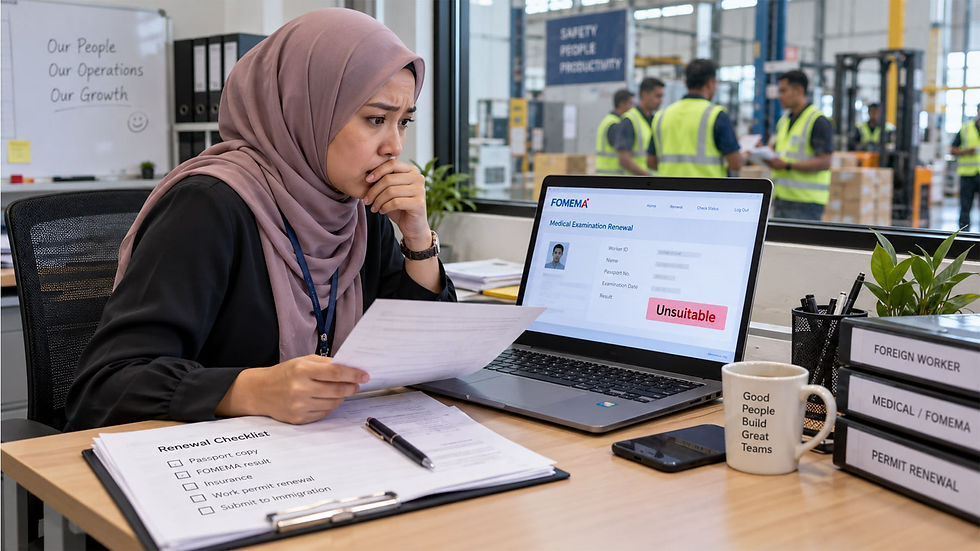
Since December 2023, annual FOMEMA screening applies to all foreign workers. A fit result is required for every renewal. A worker who fails cannot be renewed and must be repatriated via Check Out Memo. Since September 2025, that application goes through MyPASS@JIM or FWCMS online only.
Insurance Coverage
Current SPIKPA insurance coverage has to be in place. A lapsed policy holds up the renewal the same way a lapsed passport does.
How Should an Employer Renewal Checklist Be Structured?
A practical employer renewal checklist works backwards from the three-month submission window. Starting at six months gives enough buffer to catch and fix problems before they become urgent.
Six months out:
Audit passport validity for every worker due for renewal in the next six months
Flag any passport expiring within 18 months and initiate embassy renewal
Confirm security bond validity covers the next renewal period
Three months out:
Book FOMEMA clinic appointments for all workers in the renewal window
Confirm SPIKPA insurance coverage is current
Begin ePLKS submissions through FWCMS for all eligible workers
One month before expiry:
Confirm fit FOMEMA results have been uploaded
Verify eligibility status in FWCMS for each worker
Chase any outstanding documents immediately
Passport validity, bond validity, and FOMEMA timing all feed the same submission. A gap in any one of them delays the whole file, not just that section.
What Happens If Foreign Worker Permit Expiry in Malaysia Is Missed?
A late renewal does not go into a standard queue. The Immigration Enforcement Division picks it up and handles it very differently from a routine ePLKS submission.
During the review period, the worker's legal right to remain and work in Malaysia is at risk. The employer carries liability for that worker being on site without valid documentation. If the case cannot be resolved, bond forfeiture and repatriation under a Check Out Memo become the outcome.
Late filings cost far more than the paperwork they skip. A renewal filed on time costs nothing beyond keeping a calendar up to date.

Is There a Limit on How Many Times a PLKS Can Be Renewed?
Foreign workers can be employed and renewed for up to 10 years in total. Workers registered under the 6P Program are capped at 3 years. Once a worker reaches their applicable limit, the only compliant path forward is repatriation through a Check Out Memo.
Frequently Asked Questions
1. How early can employers start a PLKS renewal?
Up to three months before the current pass expires. Starting earlier than that is not possible through the ePLKS system since the application window only opens at the three-month mark.
2. What happens if a FOMEMA result comes back unfit during renewal?
The worker cannot be renewed. The employer applies for a Check Out Memo through MyPASS@JIM or FWCMS online. This application can no longer be submitted at an Immigration counter.
3. Does the foreign worker renewal process differ by sector?
The core ePLKS process is the same across sectors. Some supporting documents may vary slightly depending on the worker's role and the employer's quota category.
4. Can a renewal be submitted the day before the permit expires?
Technically yes, but there is no margin for error at that point. A missing document or an unfit FOMEMA result pushes the case past expiry with no time left to fix it.
5. What should an employer prepare when a worker is approaching the end of their renewal eligibility?
The PLKS renewal countdown does not only apply to annual expiry dates. It also applies to the 10-year employment cap (or 3-year cap under the 6P Program). Once a worker reaches that limit, no further renewal is possible. Repatriation via Check Out Memo is the only compliant path. Employers who run a tight renewal calendar should flag workers approaching their cap alongside their annual expiry dates. The preparation steps are the same: Check Out Memo paperwork, repatriation logistics, and replacement quota planning. The only difference is that no renewal comes after it.
Foreign worker permit expiry in Malaysia follows a fixed calendar. The three-month window is documented, the employer renewal checklist is specific, and the consequences of missing it are entirely avoidable. Passport validity, bond coverage, and FOMEMA timing are the three variables that most often derail an otherwise complete file. Catching them early is straightforward. Catching them late is expensive. Renewing permits for workers from Nepal, Bangladesh, or Myanmar? Talk to UMR's foreign worker permit renewal team about the renewal dates coming up in your calendar.


.png)
Comments