
What Does a Malaysia Work Permit Really Cost in 2026?

Key Takeaway
The cost of hiring foreign workers in Malaysia is not one number. It stacks government fees, statutory contributions, a refundable bond, and recruitment costs on top of each other.
Foreign worker hiring expenses include the annual levy, FOMEMA medical screening, visa processing, a security bond, and EPF contributions that became mandatory in October 2025.
The foreign worker levy cost runs RM1,850 a year in manufacturing, construction, and services, or RM640 a year in plantation and agriculture.
Recruitment cost in Malaysia sits entirely outside the government fee schedule and varies by agency, source country, and contract size.
Budgeting only for the levy leaves out the majority of what a single hire actually costs across a full year.
Introduction
The annual levy is the number most employers start with, because it appears in every government rate table and gets quoted in every agency proposal. It becomes the assumed budget line. Then the actual invoices arrive, and the real cost turns out to be higher.
The gap is not hidden in fine print. That cost is built from several separate charge categories, not one. This article breaks down every piece using 2026 figures, so the budget number you work from actually matches what you pay.
What Makes Up the Total Cost of Hiring Foreign Workers in Malaysia?
Four categories build the total. Government fees paid to the Immigration Department and FOMEMA. Statutory contributions including EPF and SOCSO. A refundable security bond. Recruitment and agency costs on top of all of that.
Employers who budget only for the levy underestimate the real cost by a significant margin. The sections below cover each category with current figures.

What Is the Foreign Worker Levy Cost in 2026?
The foreign worker levy cost is an annual charge paid to the Immigration Department for every foreign worker employed. In Peninsular Malaysia, the rate is RM1,850 a year for manufacturing, construction, and services. Plantation and agriculture sit at RM640 a year. Sabah and Sarawak operate on a separate, lower schedule.
This charge is the employer's responsibility entirely. It cannot be passed to the worker in any form, and it recurs every year the worker remains employed.
The levy is the number everyone quotes. Rarely does that figure determine the actual total cost of a hire.
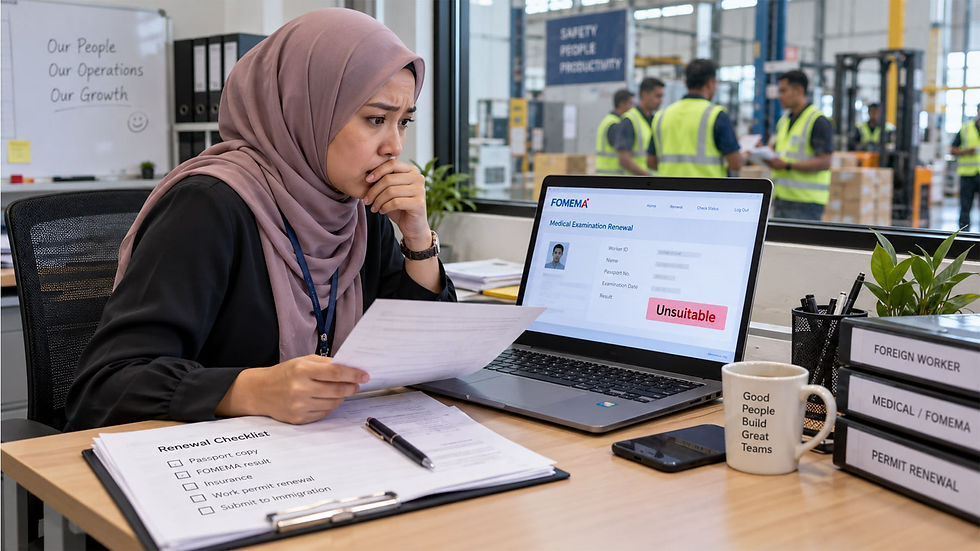
The levy also does not account for the annual FOMEMA medical screening fee, which runs separately. Male workers cost RM207 per examination. Female workers cost RM217, with the higher rate covering an additional pregnancy test. Annual screening became a mandatory requirement for all foreign workers in December 2023, so this fee repeats every year alongside the levy rather than applying only at arrival.
What Other Government Charges Add to the Foreign Worker Hiring Expenses?
Several government charges stack on top of the levy and FOMEMA fee. Together, these form the fixed portion of costs that every employer pays regardless of agency or source country.
A VP(TE) processing fee of RM60 and a separate processing fee of RM125 apply per worker. A visa fee that varies by the worker's nationality applies on top of these.
A refundable security bond sits across all of these charges. The bond amount depends on the worker's country of origin, ranging from approximately RM250 to RM1,500 per worker, and is returned once the worker is repatriated correctly through a Check Out Memo.
Since October 2025, EPF contributions have become mandatory for all foreign workers. Both employer and worker now contribute 2% of monthly wages each. This cost did not exist before that date and changes the maths for every foreign hire in the country.
A cost estimate from two years ago tells you almost nothing about what you will actually pay today. EPF contributions alone changed the calculation for every employer in every sector.
The national minimum wage of RM1,700 a month in basic salary applies equally to foreign and local workers, with no allowances counting toward that figure.
What Does Recruitment Cost in Malaysia Add to the Total?
Recruitment cost in Malaysia covers everything the government fee schedule does not. This includes sourcing candidates in the source country, pre-departure briefings, medical pre-screening before travel, airport reception on arrival, and orientation once the worker starts. None of these costs appear in any government rate table because they vary by agency, source country, and contract volume.
UMR, for example, has training consultants from Nepal, Bangladesh and Myanmar who visit clients' job sites to help with worker communication. For contracts of more than 50 workers, it also provides flights and accommodation in the source country for the selection visit. These are real cost items that sit entirely outside what the Immigration Department charges.
Zero-cost recruitment is one specific practice worth confirming with any agency before signing. This means the worker pays no recruitment fees at any stage, with the full cost borne by the employer or agency instead. Alignment with frameworks such as the Responsible Business Alliance is a useful signal, though it should still be verified rather than assumed from a website claim.
How Much Should an Employer Budget Per Worker in 2026?
Putting all four categories together gives a clearer picture of what a single manufacturing sector worker in Peninsular Malaysia actually costs per year.
Cost Category | Amount |
Annual levy (manufacturing) | RM1,850 |
FOMEMA medical fee (male) | RM207 |
VP(TE) and process fees | RM185 |
Refundable security bond | RM250 to RM1,500 |
EPF employer contribution (2% of wages) | Varies by salary |
Monthly minimum wage | RM1,700 minimum |
Recruitment cost | Varies by agency and source country |
Accommodation (Act 446 compliant) | Varies by facility |
None of these figures include the cost of providing housing. Employers must offer accommodation that meets the Workers' Minimum Standards of Housing and Amenities Act 1990. Budgeting for the levy alone captures a small fraction of the real annual cost per worker.
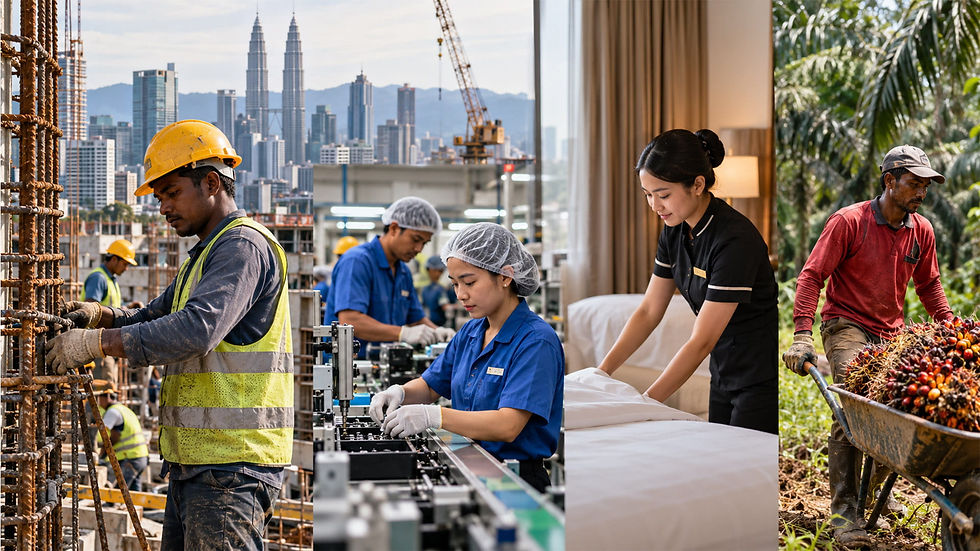
Does the Cost of Hiring Foreign Workers in Malaysia Differ by Sector?
Yes. The levy alone differs by RM1,210 a year between the two rate bands. Manufacturing, construction, services, and mining sit in the higher band at RM1,850, while plantation and agriculture sit at RM640. Sabah and Sarawak run lower levy schedules, and Sarawak adds its own surcharge under a regional transformation programme.
How Do You Build an Accurate Budget for a Foreign Worker in Malaysia?
Add the annual levy for your sector, the FOMEMA fee, VP(TE) processing charges, a visa fee based on the worker's nationality, EPF contributions at 2% of monthly wages, and your agency's recruitment fee. Then add the ongoing monthly wage cost and accommodation provision. The refundable security bond is a one-time payment per worker, returned upon correct repatriation. Multiply across your headcount for a full-picture budget number.
Frequently Asked Questions
1. What is the total cost of hiring foreign workers in Malaysia per year?
For a manufacturing sector worker in Peninsular Malaysia, the government-side cost alone runs several thousand ringgit annually once the levy, FOMEMA fee, processing charges, and EPF are combined. Recruitment costs and accommodation add further to that figure, making the levy alone a significant underestimate.
2. Why does the real work permit cost differ so much between sectors?
The levy alone varies by RM1,210 a year between the two rate bands. Manufacturing, construction, services, and mining sit at RM1,850 per worker annually in Peninsular Malaysia. Plantation and agriculture sit at RM640. Sabah and Sarawak use separate lower schedules. That gap means a factory hiring 50 workers pays roughly RM60,500 more in levy per year than a plantation hiring the same headcount. Sector is one of the biggest variables in the total cost picture.
3. Is the security bond part of the ongoing annual cost or a one-off payment?
Largely a one-off payment per worker, refunded when the worker leaves Malaysia correctly through a Check Out Memo. Unlike the levy, this is not an annual charge. For budgeting purposes, treat it as a cash-flow item rather than a recurring cost line. The levy and FOMEMA fee are what repeat every year. The bond just needs to be available and valid for the right period when each permit cycle runs.
4. Are EPF contributions now mandatory for all foreign workers in Malaysia?
Yes. Since October 2025, employers must contribute 2% of monthly wages to EPF for every foreign worker. The worker contributes a matching 2%. This applies across all sectors and was not a requirement before that date.
5. Why is the recruitment agency fee one of the hardest work permit costs to budget for in Malaysia?
Unlike the levy or FOMEMA fee, recruitment costs are not published in any government rate schedule. They vary by agency, source country, worker type, and contract volume. What one agency bundles in (pre-departure screening, airport reception, worksite training support) another may charge separately. Getting a line-by-line breakdown before signing is the only way to know what you are actually committing to, and to compare the real total cost of hiring foreign workers in Malaysia across providers.
A Malaysia work permit in 2026 costs more than the levy line on any rate table suggests. The accurate number includes the annual levy, FOMEMA fees, processing charges, EPF contributions, a refundable bond, monthly wages, accommodation, and recruitment costs that sit outside any government schedule. Getting all four categories right before a hiring decision protects the budget far more than reacting to invoices after the fact. Talk to UMR's foreign worker recruitment team about what a hire could cost for your sector and headcount.


.png)
Comments