
When Does Workforce Outsourcing Make Sense for a Growing Business?

Key Takeaway
Workforce outsourcing in Malaysia pays off at particular growth moments, such as opening a new site or winning work your own quota can't cover.
Admin grows in two ways as you expand, with a yearly permit renewal for every worker and regular inspections for every hostel.
In the 2025 quota round, new manufacturing quota went only to new investments approved by Malaysia's investment development authority.
The cap on foreign workers fell to 13% of the national workforce in 2026, and a new multi-tier levy is in the pipeline.
Outsourcing doesn't fully take housing off your hands, because the law can still treat the business that contracts the work as an employer.
Introduction
Growth feels great. Orders are rolling in, the production floor is buzzing, and someone is already scouting a second site. Then the paperwork shows up, and it's brought friends.
If your business relies on foreign workers, headcount isn't the only number going up. Every new hire and every new hostel adds its own set of government tasks. That's the point where workforce outsourcing in Malaysia becomes worth a proper look.
Timing is the tricky bit. Outsource too early, and you're paying for flexibility you don't need yet. Leave it too late, and your HR person ends up running a mini government office from their desk. So when is the right moment? Let's find out.
What Happens When Your Workforce Grows Faster Than Your HR Team?
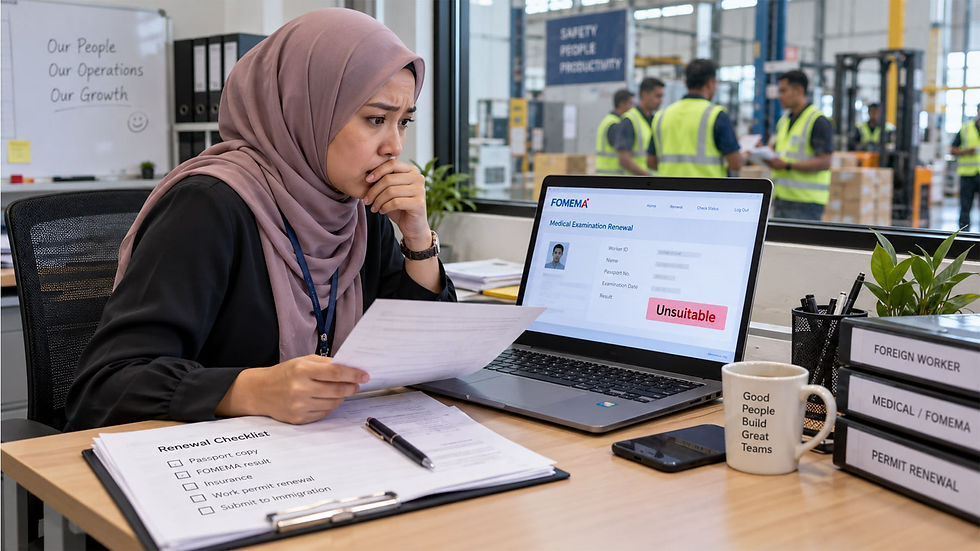
Think of each foreign worker as a small calendar of deadlines. Each work permit is valid for 12 months at a time. Every renewal then needs a fresh medical check plus a levy payment. The levy is simply the yearly government fee an employer pays for each foreign worker.
Hire five more workers, and you've got five more renewal dates. Hire fifty, and those dates can start piling into the same few weeks. Before long, a task that once sat quietly on one desk turns into a full-time job. That tipping point is the first sign worth watching.

Which Growth Signals Point Towards Workforce Outsourcing?
A heavier HR workload is one clue. Three specific growth moments make the case even clearer.
What If You're Opening a New Site?
A new site brings a brand-new layer of housing duties. By law, every hostel needs an appointed person in charge who inspects it at least twice a month. Each of those visits gets recorded, too. That person must also get any worker who feels unwell to a clinic or hospital.
One hostel is manageable. Two or three hostels in different towns mean a lot more driving and record-keeping for the same small team. This is where outsourced staffing in Malaysia starts to look sensible, especially while a new site is still settling in.
What If You Don't Qualify for Your Own Quota?
Quota is the government's approval for how many foreign workers a company can bring in. And the new quota isn't open to everyone. In the 2025 round, the new manufacturing quota focused on new investments approved by Malaysia's investment development authority. Construction was limited to government projects. Services, meanwhile, opened only for named subsectors like restaurants and laundries.
So a factory adding a line to an existing plant may simply fall outside the rules. Before you shelve the expansion, ask a licensed agency whether a manpower supply arrangement could fill the gap.
What If the New Contract Might Not Last?
Some growth arrives with a question mark attached, like a big customer contract with no promise of renewal. Hiring directly commits you to a full permit year for each worker, levy, and certified housing included. Outsourcing can let you size your team to the contract without building that base first.
If the extra demand follows a predictable season instead, that's a separate planning job.
How Do the 2026 Foreign Worker Rules Change the Maths?
The direction of travel is pretty clear. The cap on foreign workers dropped to 13% of the national workforce in 2026, down from 15%. By 2030, the goal is 10%.
More changes are queued up behind that one. A multi-tier levy, meant to discourage hiring foreign workers, was scheduled for 2026. The same plan also flagged shorter permit periods and stricter conditions for changing employer or sector.
So what does that mean for a growing business? If your share of foreign workers rises as you expand, your costs could rise with it. Check the latest levy rates before you lock in a hiring plan. Then factor them into any outsourcing quote you compare.
With the rules still tightening, every direct foreign hire is partly a bet on where next year's levy and quota rules will land.
What Doesn't Workforce Outsourcing Take Off Your Plate?
Here's a twist that's easy to miss. The same housing law defines "employer" quite broadly. It can include the owner of a workplace who brings in another party to carry out work there.
In plain terms, if outsourced workers at your site are housed badly, the law may still look your way. So before you sign, ask where the workers will live. Then ask to see the Certificate for Accommodation for each hostel.
You can outsource the hiring, yet the housing at your site can still end up on your desk.
When Does Keeping Staff In-House Make More Sense?
Outsourcing isn't a fit for every stage. Is your headcount steady and your hostel already certified? Then running hiring yourself can work well. Roles that take months to learn may also suit direct, long-term employment.
Here's a quick way to see whether workforce outsourcing in Malaysia fits where your business stands today.
Your situation | Leans towards outsourcing | Leans towards in-house |
Headcount | Rising fast or hard to predict | Stable for the next few years |
Locations | Opening a new site | One settled location |
Quota | Your project or sector doesn't qualify | You already hold approved quota |
Housing | No certified hostel near the new site | Certified hostel with spare beds |
Skills | Tasks new workers pick up quickly | Skills that take months to build |
Your business might also sit in the middle, with a settled core team and a newer site still finding its feet. In that case, staff outsourcing and direct hiring can happily run side by side. Workforce solutions in Malaysia don't have to be all or nothing.

Is Workforce Outsourcing Worth It for a Growing Business in Malaysia?
It's worth it when your growth moves faster than your approvals and HR capacity can keep up with. Opening a new site or falling outside the current quota rules are clear examples. If your headcount is steady and your hostel is already certified, hiring directly may be the simpler choice.
Frequently Asked Questions
1. How can I tell if my business has outgrown managing foreign workers in-house?
Try a simple test. List every permit renewal and hostel inspection due in the next three months, then note who handles each one. Does the same name keep showing up, with a new site about to add more? Then it's time to compare workforce outsourcing in Malaysia against hiring extra HR help.
2. Can outsourcing help me test a new location before committing?
It can. With outsourced staffing in Malaysia, a new site doesn't need your own quota on day one. You also avoid certifying a new hostel before the site has proved itself. Once it has, you can decide whether bringing that team in-house makes sense.
3. Will the multi-tier levy make outsourcing more worth it?
That depends on the final rates, which hadn't been published at the time of writing. If your share of foreign workers is climbing, it's worth modelling a few cost scenarios now. Also ask any outsourcing partner how they expect the new rates to affect the workers they supply.
4. What should a growing business ask an outsourcing partner first?
Start with whether the agency is properly licensed to supply foreign workers. Next, ask if it can supply workers near your new site. Finally, ask to see the accommodation certificate for every hostel your workers would use.
5. Can I switch from outsourced staff to direct hiring later?
Yes, but give yourself plenty of runway. The government has flagged stricter conditions for workers changing employers, so check the rules that apply at the time. You'll also want to confirm your own quota eligibility well before the switch.
So, workforce outsourcing makes sense once your growth starts outrunning the approvals and admin that come with it. A new site or a contract with a question mark over it are good moments to run the numbers. If your team is steady and your housing is sorted, doing it in-house may still be the better call. Whichever way you go, keep an eye on the 2026 rule changes, because they could shift the maths again. Planning your next stage of growth? Talk to UMR's foreign manpower supply and consultancy team about which setup suits your plans.


.png)
Comments